How Sound Moves Through Walls
Sound travels through walls primarily by causing the wall surfaces to vibrate, which re-radiates sound on the other side. Mass helps — heavier walls vibrate less easily. Decoupling helps more — if the two wall surfaces aren't rigidly connected, vibration from one side has a harder time transferring to the other. Damping (absorbing vibration energy before it can radiate) adds another layer of control.
Standard wall construction scores around STC 33-38 on the Sound Transmission Class scale, which means a loud conversation on one side is audible but not intelligible on the other. An STC 50 wall makes that conversation nearly inaudible. An STC 60 wall effectively blocks it for most practical purposes. The International Building Code requires STC 50 or better for walls between dwelling units in multi-family buildings, per IBC Section 1206.
Specialty Soundproof Drywall Panels
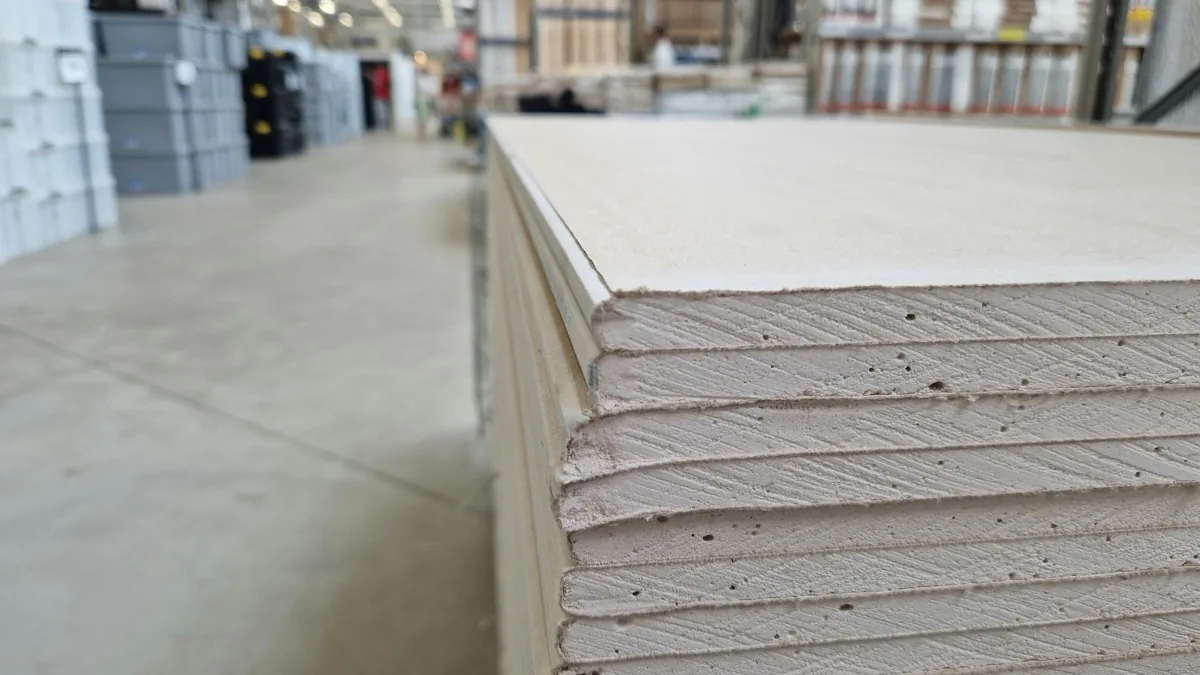
Products like QuietRock, SoundBreak XP (National Gypsum), and SilentFX (CertainTeed) are standard gypsum panels with a viscoelastic damping compound bonded between layers. The damping compound converts mechanical vibration energy into a small amount of heat rather than letting it travel through the panel. They install identically to standard drywall — same screws, same tape and mud — but weigh noticeably more.
Performance and Cost
QuietRock 530 is the most widely referenced product and gives STC improvements of roughly 8-12 points over a standard single-layer assembly when installed correctly. A basic wood-stud wall with insulation and one layer of standard 5/8 drywall might test at STC 37. The same assembly with QuietRock 530 might reach STC 45-50.
Cost is the issue. QuietRock 530 runs approximately $60-70 per 4x8 sheet at major retailers as of early 2026. Standard 5/8 drywall runs $14-18 per sheet. For a 12x12 room with 8-foot ceilings, you'd need roughly 24 sheets for four walls, which translates to a cost difference of about $1,000-1,200 compared to standard drywall. That premium may or may not be worth it depending on your goals and budget.
Where They Make Sense
Specialty panels make the most sense when you can't use thicker assemblies due to space constraints, or when you're retrofitting sound isolation into an existing finished space with minimal disruption. They're also useful when decoupled construction isn't feasible — if you're drywalling directly to masonry, for example. For new construction where you have full control of the wall assembly, the same money often goes further with other approaches.
Double-Layer Standard Drywall with Damping Compound
An alternative that achieves similar results at lower cost: two layers of standard 5/8 drywall with a bead of viscoelastic damping compound (Green Glue being the most common brand) between the layers. The compound does the same work as the damping layer in specialty panels, but you're buying commodity drywall and a $20-25 tube of compound rather than paying 4x for the pre-laminated version.
A typical double-layer assembly with Green Glue on a standard wood-stud wall with batt insulation tests around STC 48-52. That's competitive with specialty panels at a lower installed cost when material prices are compared. The tradeoff is added weight (two layers plus compound) and the labor of hanging and finishing two layers of drywall, which roughly doubles the drywall time for those surfaces.
Green Glue's published test data and installation instructions are available on their site. The compound needs to be applied in a specific pattern (S-curves or dots, not a full spread) and the second layer attached before it dries. Follow the instructions carefully — improper application noticeably reduces performance.
Resilient Channels and Decoupled Assemblies
If you want serious sound isolation, decoupling is where the gains are. Resilient channels are thin metal hat-shaped channels that attach to the studs horizontally, with the drywall screwed to the channels rather than directly to the framing. The channel flexes slightly, breaking the rigid connection between the wall surface and the structure. Done correctly, this can add 8-15 STC points over a standard assembly.
The tradeoff is that resilient channels are unforgiving of installation mistakes. Every screw that accidentally contacts a stud directly — called a short circuit — compromises the decoupling and reduces performance dramatically. Some installers find that staggered-stud or double-stud wall framing gives more reliable decoupling, since there's no way to accidentally short-circuit a wall where the two stud rows share no physical contact. Those assemblies cost more in framing materials and sacrifice 3-5 inches of room width per wall, but they're more reliable.
The Acoustical Society of America maintains resources on building acoustics and testing methods at acousticalsociety.org for those who want to go deeper into the technical side.
What to Do About the Weak Points
One thing worth knowing before you invest in any of these approaches: sound isolation is only as good as the weakest path. You can build an STC 55 wall and have it perform like STC 40 because of gaps around electrical boxes, penetrations for pipes or cables, or because the floor and ceiling connections weren't treated. HVAC ducts that run through multiple rooms are particularly bad — sound travels freely through ductwork regardless of what the surrounding walls do.
For practical home projects, the priority order is usually: seal all penetrations and gaps first, add insulation to any unfilled cavities, then upgrade the wall assembly if the baseline still isn't good enough. In my experience, people often skip the sealing step and wonder why their expensive drywall didn't help as much as they expected.
Typical Cost Ranges
These are rough material-only figures for a 100-square-foot wall surface as a comparison baseline:
Standard single layer (5/8 drywall + insulation): $60-80 in materials. STC approximately 35-40.
Double layer with Green Glue: $120-160 in materials. STC approximately 48-54.
QuietRock 530 single layer: $180-210 in materials. STC approximately 45-52.
Resilient channel + standard drywall + insulation: $90-120 in materials if installed carefully. STC approximately 45-55 (variable based on installation quality).
Double-stud wall + standard drywall + insulation: $150-220 in materials. STC approximately 55-65. Loses 4-6 inches of room width per wall.
Labor costs vary widely by region. For any of these approaches, the framing and insulation work is standard; drywall hanging is standard except for double-layer (more time) and resilient channel (higher skill requirement to avoid short circuits).