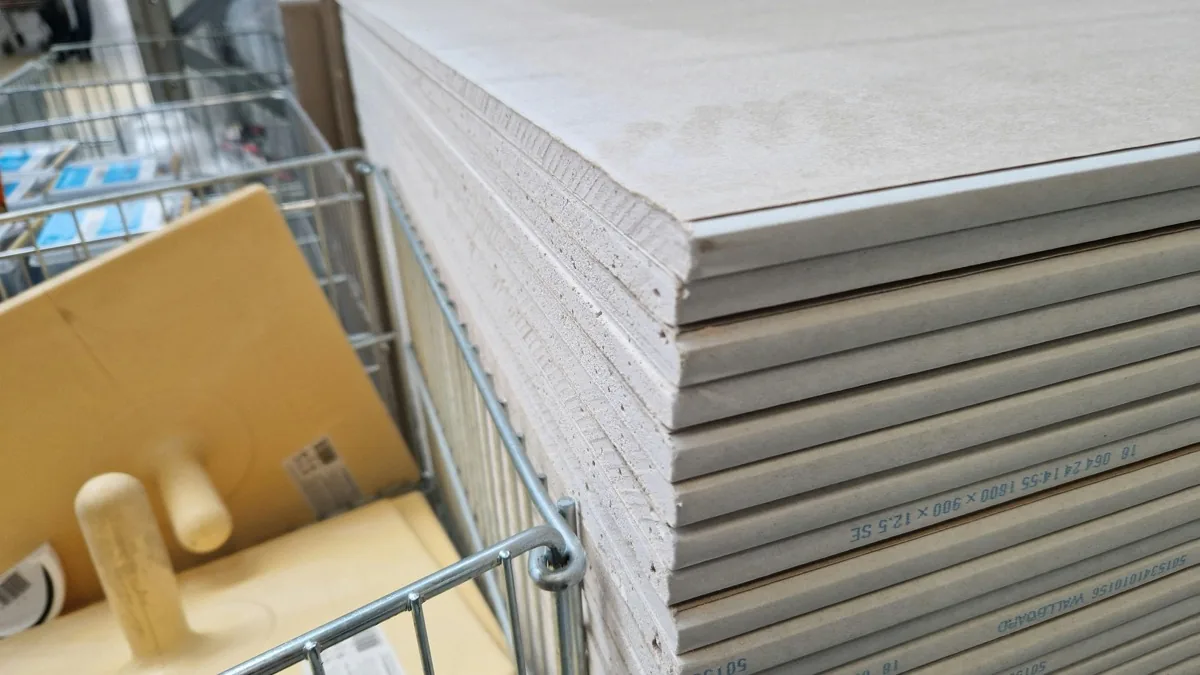
What Makes Drywall Fire-Rated
Standard drywall is gypsum sandwiched between paper. Gypsum is naturally fire-resistant because it's a crystalline mineral that contains water — calcium sulfate dihydrate. When heated, that water converts to steam, which absorbs heat and slows the temperature transfer through the wall. Even standard 1/2-inch drywall provides roughly 30 minutes of fire resistance before significant heat passes through.
Type X drywall extends that rating to 60 minutes per layer through three changes:
Increased thickness. Type X is 5/8 inch, not 1/2 inch. More gypsum means more mass to absorb heat and more water to convert to steam before the panel fails.
Glass fiber reinforcement. Chopped glass fibers are blended into the gypsum core. As the panel heats and the gypsum starts to calcinate and lose its bound water, the glass fibers hold the panel together mechanically. This keeps the barrier intact longer than a panel that would crumble without the reinforcement.
Denser core formulation. The gypsum mix is denser than standard drywall, which slows heat transfer further.
The resulting assembly — Type X drywall on both sides of wood-framed 2x4 studs with standard spacing — is rated to contain fire to one room for approximately one hour. That's the target rating for residential fire separations in most code applications.
Type X vs Type C
Type C is an enhanced fire-rated product that contains additional materials — typically vermiculite or other shrinkage-compensating additives — that improve performance over Type X at high temperatures. Where a two-layer Type X assembly achieves a 2-hour rating, Type C can sometimes achieve the same in fewer layers.
For residential DIY applications, you will almost always see Type X specified. Type C is more common in commercial construction and is typically special-order at home improvement stores, running $18-28 per sheet versus $12-16 for standard Type X. Unless your inspector or permit specifically calls for Type C, you don't need it.
Where Building Codes Require It
The International Residential Code (IRC) is the model code that most US jurisdictions have adopted, often with local amendments. It specifies fire-rated assemblies in several residential locations:
Attached garages: IRC Section R302.5 requires that the walls and ceiling separating an attached garage from living space — including rooms above the garage — use fire-rated material on the garage side. The standard requirement is 5/8-inch Type X on the garage side, or an equivalent-rated assembly. This is the requirement that catches the most DIYers. If you're drywalling an attached garage, or if you're adding living space above an existing attached garage, this applies.
Enclosed utility rooms: Rooms that enclose a furnace, boiler, or water heater are often required to have Type X walls in local codes. This is where I ran into trouble in my basement. The specific requirements vary more by jurisdiction than the garage rule, but it's common enough that you should verify before finishing an enclosed mechanical space.
Stairwells: Primarily applies to multi-family and townhome construction, but some local codes extend this to accessory dwelling units and certain basement stair enclosures. Check with your local building department if you're enclosing a stairwell.
Townhome and condo party walls: The shared wall between attached units typically requires a 1- or 2-hour fire-rated assembly. This is a concern for new construction or major renovation, not typical repair work.
How to Verify Your Local Requirements
The IRC is a model code. Your jurisdiction may have adopted a different version, added local amendments, or have additional requirements. Before starting a project where fire-rated drywall might be required, call or visit your local building department. Explain the project type and ask what's required. Most building permit offices can answer this kind of question in a 10-minute phone call without you needing to pull a formal permit.
The National Fire Protection Association (NFPA) publishes the standards that underlie most residential fire codes. Some resources are available at nfpa.org, though the full code documents typically require purchase or library access.
Cost Difference and Where to Buy
Type X is a standard product at Home Depot, Lowe's, and most building supply yards. It is not special order.
Typical pricing for Midwest markets as of early 2026:
Standard 1/2-inch drywall (4x8): $9-11 per sheet
Type X 5/8-inch (4x8): $12-16 per sheet
Type X 5/8-inch (4x12): $17-22 per sheet
The premium is roughly $3-5 per sheet. For a typical attached garage project — say 400 square feet of wall surface needing Type X — you're looking at about 25 sheets, or $75-125 more than standard drywall. That's real money but not a reason to skip the requirement. A failed inspection and forced redo will cost significantly more.
Type X is easy to identify in the store. It's thicker and heavier than standard drywall, and the face or back paper usually notes "Type X" or "Fire Code" along with a UL (Underwriters Laboratories) designation. Some manufacturers use orange or yellow face paper to distinguish it visually. If you're unsure, read the back paper — it should explicitly state the fire rating.
Installation Differences
Type X weighs more. A 4x8 sheet of 5/8-inch Type X runs about 70 pounds, compared to 55 pounds for 1/2-inch standard. For ceiling applications — garage ceilings are the most common fire-rated ceiling installation — that extra weight matters significantly. Rent a drywall lift for ceiling work if you're working alone or with limited help. Trying to hold 70-pound sheets overhead while driving screws is genuinely dangerous.
Fastener spacing is more specific for fire-rated assemblies. The IRC specifies screw spacing requirements for rated assemblies — typically screws at 8 inches on center for ceiling work versus 12 inches for standard drywall. Follow the specific requirements for your application and verify them with your inspector.
Seams must be taped and finished. A fire-rated assembly requires properly taped joints. Unfilled seams compromise the assembly's fire performance. This is standard finishing work, but it means you can't take shortcuts on joint treatment in a fire-rated area.
Don't mix standard drywall into a fire-rated assembly. If you need to patch a section of garage wall that's otherwise Type X, the patch must also be Type X or an equivalent-rated material. A standard 1/2-inch patch in a fire-rated wall voids the assembly rating for that section.
Cutting and Fastening
Cuts the same way as standard drywall: score with a utility knife, snap over a straight edge, cut the back paper. The extra thickness requires more scoring pressure. A carbide-tipped scoring knife handles the denser core better than a standard utility blade, especially if you're doing a lot of cuts. The glass fiber reinforcement also dulls blades faster than standard drywall — plan to change blades more frequently than you would with 1/2-inch material.
Use drywall screws long enough to penetrate at least 5/8 inch into the framing member. For Type X on 2x4 studs, 1-5/8 inch screws are the minimum; 1-7/8 inch or 2-inch screws give better bite and are what most contractors use.
Common Questions
Can I use two layers of 1/2-inch standard drywall instead of one layer of 5/8-inch Type X? No. Standard 1/2-inch drywall doesn't have the glass fiber reinforcement in the core that gives Type X its fire rating. Two layers of standard drywall adds mass but doesn't match the performance of Type X. Two layers of 1/2-inch Type X achieves a 2-hour rating in some assemblies — but that's Type X, not standard.
Does Type X require special tape or compound? No. Standard paper or mesh tape and all-purpose joint compound are fine for finishing Type X. The fire resistance is in the panel, not the finishing materials.
Do all garage walls need Type X, or just certain ones? The fire separation requirement applies to surfaces that separate the garage from living space. The exterior garage walls — the ones facing outside — typically don't need fire-rated drywall. The wall between the garage and your house interior, and the ceiling of the garage if there's living space above it, are the fire separation surfaces. Your local building department or inspector can confirm exactly which surfaces apply to your specific layout.
My garage already has drywall but it's 1/2-inch standard. Do I need to fix it? If you're not pulling a permit for new work, existing non-compliant drywall is typically not triggered for upgrade. If you're doing a permitted project in the garage, the inspector may require any existing non-compliant surfaces to be brought up to code as part of the project. Ask before you start.