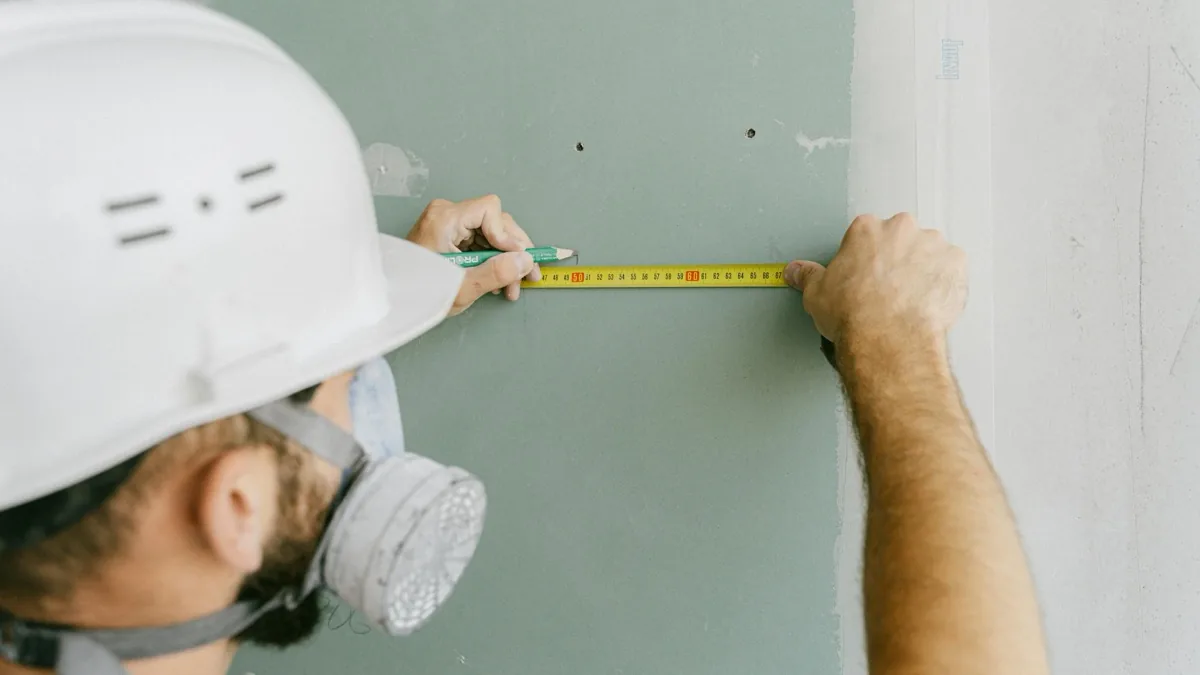
Why Feathering Matters
Joint compound shrinks as it dries. A thick application in the center of a patch will shrink more than a thin application at the edges, which creates a slight depression if you're not careful. More importantly, any abrupt edge where compound meets bare drywall paper will show up as a line under paint, no matter how well you sand.
The goal of feathering is to eliminate those hard transitions. You want the compound to gradually thin out over a wide area so the edge essentially disappears — the transition from compound to bare wall happens over several inches rather than a sharp line.
This is why patching with one thick coat almost never works. You can sand forever and still see the patch. Multiple thinner coats, each slightly wider than the last, are what actually hide repairs.
Tools and Materials
You don't need much, but knife size matters more than most beginners realize:
Knives: A 6-inch knife for first coat and tight spots, a 10-inch or 12-inch knife for finish coats. The wider knife is what makes good feathering possible. You can't feather a 12-inch wide coat with a 6-inch knife without leaving marks.
Compound: Pre-mixed all-purpose for first and second coats, finishing compound (also called topping compound) for the final coat if you want the smoothest result. Finishing compound is thinner and sands more easily. If you only have all-purpose on hand, it works fine — just thin it slightly with water for the last coat.
Lighting: A work light or clamp lamp positioned at a low angle to the wall. This is not optional. You will miss ridges and edges under overhead lighting that a raking light reveals immediately.
On Knife Width
The 12-inch knife intimidated me for years. It felt unwieldy and I kept going back to the 6-inch because it was easier to control. What changed was watching a professional mud a wall and realizing the wide knife wasn't about applying more compound at once — it was about how the pressure distributed across the blade to create a thin, even edge.
Once I understood that, I stopped fighting it. The wide knife does the feathering almost automatically if you hold it at the right angle and lighten your grip toward the end of the stroke.
First Coat: Fill and Tape
The first coat isn't really about feathering yet. Your goal is to fill the repair, embed tape if needed, and get the area level. Apply enough compound to fill the void and cover the tape, but don't go wider than you need to.
At this stage, extending the compound 2-3 inches beyond the patch edges is enough. Don't try to perfect the feathering here — the first coat will have ridges and that's fine. Sand lightly once it's fully dry (usually overnight, but verify by color — wet compound looks darker).
Remove any ridges or tool marks with your knife or a light pass of 120-grit before the second coat. You're not trying to make it smooth yet, just flat enough that the next coat goes on without bridging over bumps.
Second Coat: Widen and Start Feathering
This is where feathering begins in earnest. The second coat should extend 3-4 inches beyond the first coat on all sides. You're building a graduated transition zone.
Technique for the feathering stroke:
Load the knife with a moderate amount of compound. Apply it from the center of the patch outward. As you approach the outer edge of the coat, gradually reduce downward pressure on the knife. Let the trailing edge of the blade lift slightly off the wall at the end of the stroke.
The result should be a coat that's thicker at the center and thins to almost nothing at the outer edge. Run your hand across it when wet — you should feel a gradual slope, not a hard edge.
Apply the feathering stroke in multiple directions. Don't just go left-right. Overlap strokes at angles to blend out any ridges from individual passes. Let dry fully, sand lightly with 120-grit, and wipe clean before coat three.
Dealing with Ridges Between Strokes
Ridges between knife strokes are normal and expected. They happen when the edge of one stroke overlaps the edge of another at different thicknesses. Don't try to smooth them wet — you'll just drag compound around and make more marks. Let the coat dry completely, then sand the ridges down. The next coat smooths over the result.
Third (Finish) Coat: Wide and Thin
The final coat should extend 6-8 inches beyond the original patch — wider than most beginners expect. You're using a very thin layer at this point, essentially a skim coat around the perimeter, to eliminate any remaining transition lines.
Switch to finishing compound if you have it. Thin it with a small amount of water until it spreads like mayonnaise rather than peanut butter. Use the 12-inch knife.
Apply with light pressure and long strokes. The goal is not to add material — it's to fill any remaining texture differences between the compound and surrounding wall. The finish coat should be thin enough that you can almost see through it.
When dry, use your low-angle light to inspect. Look for ridges, edges, and any spots where compound meets wall sharply. Sand with 150-grit followed by 220-grit. The final surface should feel continuous when you run your hand across the patch boundary.
When You See an Edge After Sanding
If you still see a line after the third coat dries and you've sanded, apply a fourth coat — this time only at the edges. You're not re-doing the whole patch; you're extending the feather zone slightly wider. A thin skim coat extending 2-3 inches beyond the current boundary is usually enough to eliminate stubborn edge lines.
Four coats is not unusual for patches larger than a few inches. It's not a sign that you did anything wrong; it's just how the process works on larger repairs.
Common Feathering Mistakes
Not extending wide enough: The single most common issue. People feather 2 inches when they should feather 8. A bigger feather zone makes the transition less visible, not more.
Using too much compound on finish coats: Thick finish coats create ridges that are hard to sand smooth. Thin coats that build gradually produce better results than trying to cover everything in one pass.
Sanding before fully dry: Wet compound tears and pills. It looks dry on the surface and is still wet underneath. Wait until the color is uniform and it feels hard, not soft, when you press it.
Skipping low-angle lighting: You will sand a patch, think it looks good under overhead light, prime it, and see every flaw when paint goes on. The raking light check takes two minutes and prevents repainting the same spot three times.
For more on the overall process, the USG finishing guide has detailed technical specifications for each coat level if you want to understand what professional standards expect.